
The Billows
They've come to collect
This is my entry for Vanessa Perry’s collaborative folk-inspired writing event. Writing this was an honour, because I felt I could include a lot of small details that relate to the folklore I grew up with. In the Author’s Note at the bottom, I talk a little about the greatest sources of inspiration.
They flew in the day after the summer solstice, riding on larksong. Gossamer shirts billowed, puffing up around their translucent bodies, the small designs burned red into the sheer fabric. Seeing them the first time, Doina finally understood why their existence was debated. Even up close, they were so delicate as to be almost incorporeal.
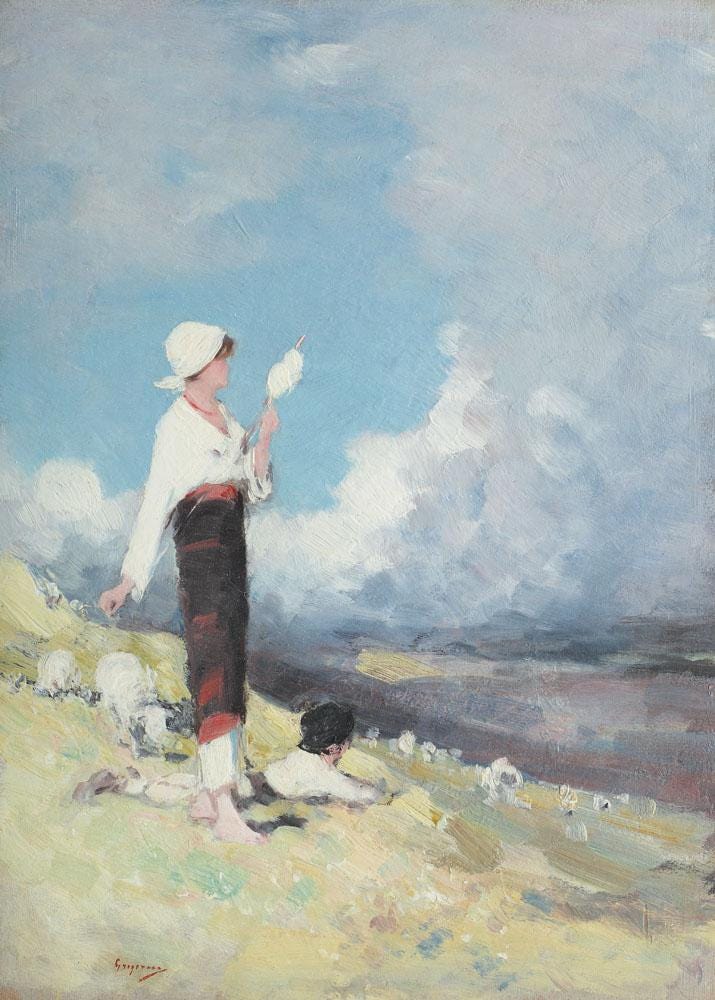
“Welcome,” she said to the first one that landed, whose ie1 bloomed with the Tree of Life. “I do not have bread or salt with me, but we’d be honoured to welcome you as guests in our village.”
“We accept,” Tree of Life spoke, her voice a sweet zephyr.
Doina’s little sister, Mioara, ran ahead to announce the cheerful news. Slower, shimmering in the dust perturbed by the little girl’s feet, the Billows walked in silence alongside Doina. Even the sheep seemed to understand the importance of the event for they didn’t stray as usual, but kept to the dirt road. Doina’s ciomag2 thunked periodically on the dirt, grinding the cracked soil into dust. Finally they’re here. Thunk. Finally we’ll have rain. Thunk.
She’d heard the legends from her great-grandmother, a woman who seemed to have been born old and blind for everyone remembered her as such. The crone would bring Doina and the other children in the village into her spacious yard and spun yarn while teaching them of life: “Welcome strangers with open arms, and give them salt and bread to show your friendship, lest you be struck by misfortune.”
If the crone was in good spirits, she would venture into the world of fairytale, too. Such as the Billows, the wisps of departed women who brought gifts to those they visited.
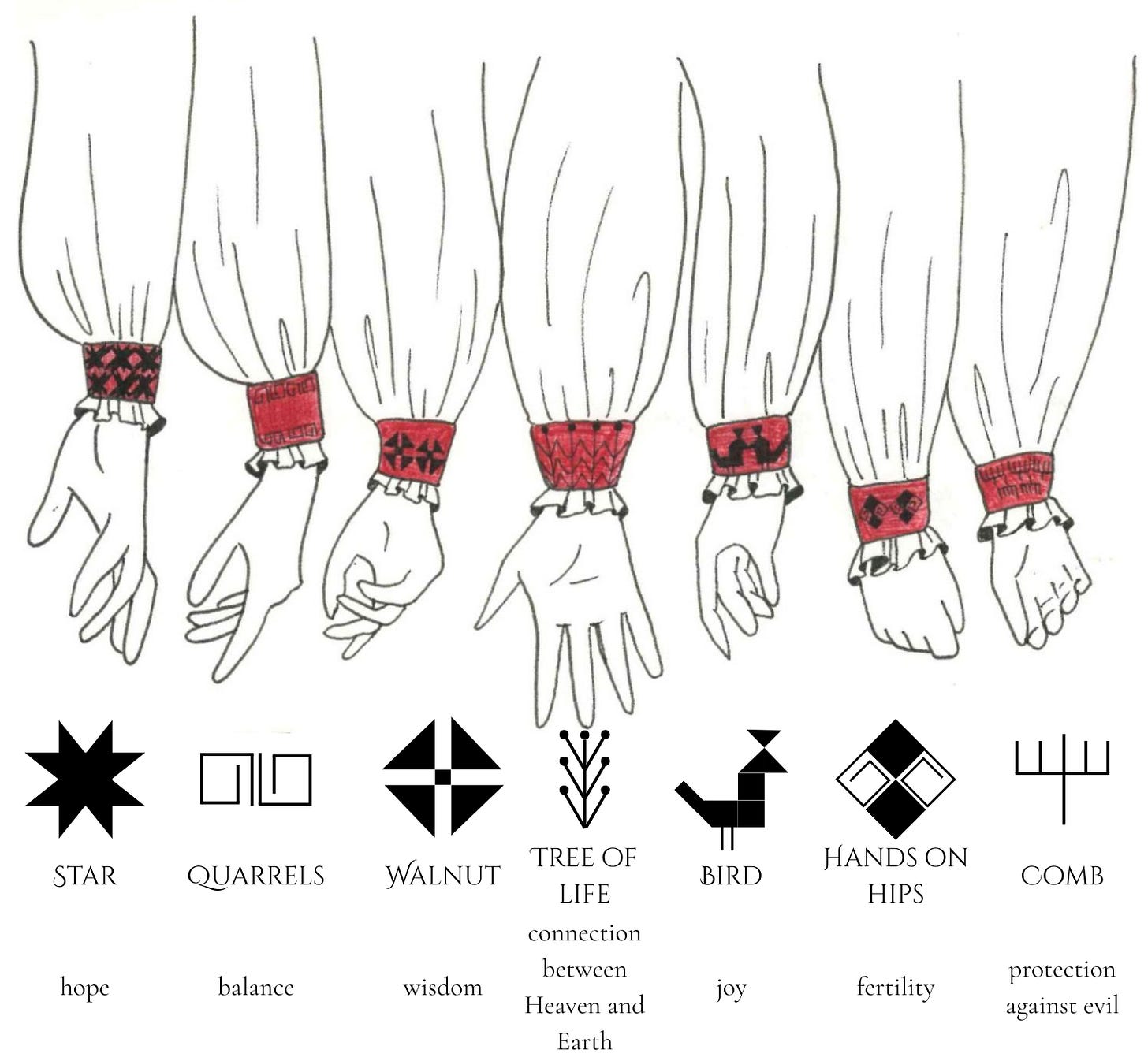
“They had to leave their homes behind. Family, husbands, children,” the crone spoke slowly, chewing her lips in moments of silence. “They need to be a complete set, the seven of them. Each wears an ie with red-threaded embroidery of their gifts. The Star brings hope. The bearer of the Quarrels keeps the world in balance. The Comb protects against evil. Wisdom comes from the Walnut, and fertility from Hands on Hips. The Bird is the bearer of joy. And the final one, dressed with the Tree of Life, connects Heaven and Earth.
The Billows would only pass through villages when in need of something. Otherwise, they’d stay in the sky, nestled in clouds and wrapped in summer breezes, watching over the lands below and bestowing gifts at will. If their three pleas were fulfilled, they’d give those that helped them a gift--usually 7 years of luck and abundance, which Doina’s village desperately needed.
Doina preferred to push the last part of the legend to the back of her mind. She needn’t think of what they’d do if their desires were not fulfilled. She tried not to look at the embroidered signs burning in their shirts.
When they stepped foot on the main street, people had already swarmed out, bearing wine and țuică and bowls of salt and crackling loaves of bread. Mioara grinned, red-faced and dusty, from behind their mother and brothers. She had fulfilled her duty, and the Billows could be welcomed properly. The first of three jobs was done.
Most men in the village had abandoned their work and took to raising a makeshift tent of branches and leaves in a clearing in the forest. The Billows preferred sleeping close to nature, and they needed somewhere they would have privacy and a fresh spring to wash in. Once they’d approve of their dwellings, the second job would be complete.
Then only the third would remain.
“Which one is missing?” Doina heard Mioara whisper to no one in particular, as the village teacher pointed the Billows to a richly decorated table waiting for them in the church yard.
It was the Comb, Doina had already noticed, and a knot had formed in her throat.
“We have a babe of one,” a voice rang over the chatter. “She hasn’t made the choice yet. Oh, mighty Billows, would you like to see?”
“We would,” said the Quarrels. “We would be honoured, and we’d thank you for the honour by gifting the babe a chest of gold.”
The babe’s mother, blushing with pride and greed, brought her apple-cheeked child, still dusty from rolling in the sand and placed her squarely in the middle of the church yard. The child’s eldest brother came running with the carved slices of wood, rubbed smooth by generations of tiny fingers. He arranged them in a circle around the smiling baby.
The little girl, unused to being the center of attention, clapped her hands and yelped with joy, then laughed when the entire village joined her. She rolled onto her stomach and crawled, deftly, to one of the rounds of wood. The baby looked intently at the symbol, then turned sharply and grabbed the one to the left. The Comb.
“The second Comb in our village in nearly a century,” thought Doina.
The symbol of the Comb burned in Doina’s Sunday ie, folded nearly in her dowry chest. The simple shirt, dusty and stained, she wore on normal days had protected her against the Billow’s scrutiny, but once she’d don her best clothes for the feast that night, the six would see she bore the symbol of their lost sister and bring Doina in their midst. They’d take her away, on rays of sun and linden smell, to their realm. Away from her sister, from her village. From her beloved sheep.
“How fortunate,” the Walnut spoke, her voice a ring of silver bells. “It is indeed the Comb we’re missing.”
The cheering in the church yard stopped. The baby tried to shove the piece of wood in her mouth, happy to play with a new toy. The mother picked her up and held her close.
“Our prior Comb has perished,” the Hands on Hips spoke next, her silver hair floating of its own accord. “Died in a flood. She was young, too, went before her time. So we urgently need a new one.”
“My baby is too young,” the mother choked, tears blooming in her eyes. Oh, how she regretted her excitement. If only she’d waited until the Billows left, her child wouldn’t have been in peril. She no longer cared about the gold the Billows would give the baby as thanks for the honour.
“She is too young,” the Star conceded. Barely more than a teenager herself, her voice flowed low and deep, like a mountain river. “There must be another Comb that can join us.”
The villagers turned, slow and deliberate, towards Doina. The only other Comb in a century.
“It is you,” an old man said, spitting. “You have the Comb, don’t you?”
Doina’s voice quivered. “Yes.”
The Bird smiled wide and brought Doina’s hands into hers. If Doina would join them, the Bird would be her sister, not her beloved Mioara. She tried to close her eyes and see if she felt any familiarity with the Billow, but there was none. How could there be?
“Will you relinquish your life as is now, and your earthly body, and your blood, and join us in our celestial plains? Will you give up the life of sorrow on earth and take on the gifts of benefaction?”
Doina took a deep breath, taking in the smell of wildflowers and wilted grass. The crone’s voice rang in her ears.
“If disobeyed once, the Billows take away the sight of all those who have seen them. Those so accursed shall never again receive good luck from them again. If disobeyed twice, they pluck the souls of those that refused them and spin them into thread for their shirts. The bodies are still alive until their natural end, but there is nothing left to ascend to Heaven afterwards.”
“What about the Billows?” Doina had asked as a young girl.
“Their souls are broken into gifts for those on earth. They never get to Heaven either.”
Doina looked at the little girl, the second Comb, now crying in her mother’s arms.
“It shall be my honour to join you,” she told the Billows, and the village erupted in cheers.
The third job was complete, and the clouds gathered at once, raining blessed water onto the dying crops.
Author’s note: There are multiple connections to Romanian folklore in the story.
The Billows do not exist, but they’re heavily inspired by Sânziene (s-uhn-zee-eh-neh), which are benevolent mythical beings akin to good fairies. The Sânziene are celebrated on the 24th of June, when the skies are said to open (that’s when the Billows came to Earth).
The symbols on the Billows’ shirts are actual symbols used in traditional Romanian embroidery, and the meaning are the actual meaning behind them. I’ve attached a drawing of what the symbols actually look like, and I’ll try to share a picture of some of my own traditional blouses that include these motifs.
The traditions mentioned (welcoming guests with salt and bread, 1 year olds choosing items from a tray to determine their fate) are real Romanian traditions.
Doina (meaning ballad) and Mioara (meaning sheep) also have deeper meanings: both are traditional names referencing the foundational Romanian folk poem, Miorița. In the poem, a shepherd hears from his magical ewe that two other shepherds plan to kill him. He resigns to his fate (like Doina resigned to hers) and instructs the ewe to tell his mother and the other sheep he has gone to marry a princess. If they think this is the truth, they will be less sad. In The Billows, Doina will also have to leave behind all she knows, although it is a much more whimsical alternative to death. In a way, her fate is similar the the one the shepherd in the ballad wanted everyone to think he had.
© 2026 Laura Teodorescu. All rights reserved. No part of this work shall be reproduced or distributed without author’s permission, this includes inputting the work into LLMs to create summaries.
Traditional Romanian embroidered blouse
Club, used by shephers to guide sheep
What a beautiful storry, I really love all the symbolism you put into it!
Love the detail about the embroidery. Those are so interesting?
The bread and salt thing is quite similar to a Russian custom, too.
Enjoyed this 🖤